Wednesday, January 6, 2016
These are the Facts
I'm going to publish these basic facts as written by Mark Twain (Samuel Clemens) in 1909.
You can use these to refer to when I or anyone else is disputing something.
These facts come from the book - Is Shakespeare Dead? Chapter 3
This Book can be read on Project Gutenberg
All CAPS are in the Original Book.
__________________________________________________________
For the instruction of the ignorant I will make a list, now, of those details of Shakespeare's history which are FACTS--verified facts, established facts, undisputed
Facts
He was born on the 23d of April, 1564.
Of good farmer-class parents who could not read, could not write, could not sign their names.
At Stratford, a small back settlement which in that day was shabby and unclean, and densely illiterate. Of the nineteen important men charged with the government of the town, thirteen had to "make their mark" in attesting important documents, because they could not write their names.
Of the first eighteen years of his life NOTHING is known. They are a blank.
On the 27th of November (1582) William Shakespeare took out a license to marry Anne Whateley.
The very next day William Shakespeare took out a license to marry Anne Hathaway. She was eight years his senior. William Shakespeare married Anne Hathaway. In a hurry. By grace of a reluctantly granted dispensation there was but one publication of the banns. Within six months the first child was born.
About two (blank) years followed, during which period NOTHING AT ALL HAPPENED TO SHAKESPEARE, so far as anybody knows.
Then came twins--1585. February.
Two blank years follow.
Then--1587--he makes a ten-year visit to London, leaving the family behind.
Five blank years follow.
During this period NOTHING HAPPENED TO HIM, as far as anybody actually knows.
Then--1592--there is mention of him as an actor.
Next year--1593--his name appears in the official list of players.
Next year--1594--he played before the queen. A detail of no consequence: other obscurities did it every year of the forty-five of her reign. And remained obscure.
Three pretty full years follow. Full of play-acting. Then on 1597 he bought New Place, Stratford.
Thirteen or fourteen busy years follow; years in which he accumulated money, and also reputation as actor and manager. Meantime his name, liberally and variously spelt, had become associated with a number of great plays and poems, as (ostensibly) author of the same. Some of these, in these years and later, were pirated, but he made no protest.
Then--1610 or 1611--he returned to Stratford and settled down for good and all, and busied himself in lending money, trading in tithes, trading in land and houses, shirking a debt of forty-one shillings, borrowed by his wife during his long desertion of his family; suing debtors for shillings and coppers; being sued himself for shillings and coppers; and acting as confederate to a neighbor who tried to rob the town of its rights in a certain common, and did not succeed.
He lived five or six years--till 1616--in the joy of these elevated pursuits. Then he made a will, and signed each of its three pages with his name. A thoroughgoing business man's will. It named in minute detail every item of property he owned in the world--houses, lands, sword, silver-gilt bowl, and so on--all the way down to his "second-best bed" and its furniture. It carefully and calculatingly distributed his riches among the members of his family, overlooking no individual of it.
Not even his wife: the wife he had been enabled to marry in a hurry by urgent grace of a special dispensation before he was nineteen; the wife whom he had left husbandless so many years; the wife who had had to borrow forty-one shillings in her need, and which the lender was never able to collect of the prosperous husband, but died at last with the money still lacking. No, even this wife was remembered in Shakespeare's will. He left her that "second-best bed."
And NOT ANOTHER THING; not even a penny to bless her lucky widowhood with. It was eminently and conspicuously a business man's will, not a poet's.
It mentioned NOT A SINGLE BOOK. Books were much more precious than swords and silver-gilt bowls and second-best beds in those days, and when a departing person owned one he gave it a high place in his will. The will mentioned NOT A PLAY, NOT A POEM, NOT AN UNFINISHED LITERARY WORK, NOT A SCRAP OF MANUSCRIPT OF ANY KIND.
Many poets have died poor, but this is the only one in history that has died THIS poor; the others all left literary remains behind. Also a book. Maybe two.
If Shakespeare had owned a dog--but we not go into that: we know he would have mentioned it in his will. If a good dog, Susanna would have got it; if an inferior one his wife would have got a downer interest in it. I wish he had had a dog, just so we could see how painstakingly he would have divided that dog among the family, in his careful business way.
He signed the will in three places.
In earlier years he signed two other official documents.
These five signatures still exist.
There are NO OTHER SPECIMENS OF HIS PENMANSHIP IN EXISTENCE.
Not a line.
Was he prejudiced against the art? His granddaughter, whom he loved, was eight years old when he died, yet she had had no teaching, he left no provision for her education, although he was rich, and in her mature womanhood she couldn't write and couldn't tell her husband's manuscript from anybody else's. She thought it was Shakespeare's.
When Shakespeare died in Stratford, IT WAS NOT AN EVENT. It made no more stir in England than the death of any other forgotten theater-actor would have made. Nobody came down from London; there were no lamenting poems, no eulogies, no national tears--there was merely silence, and nothing more. A striking contrast with what happened when Ben Jonson, and Francis Bacon, and Spenser, and Raleigh, and the other distinguished literary folk of Shakespeare's time passed from life! No praiseful voice was lifted for the lost Bard of Avon; even Ben Jonson waited seven years before he lifted his.
SO FAR AS ANYBODY ACTUALLY KNOWS AND CAN PROVE, Shakespeare of Stratford-on-Avon never wrote a play in his life.
SO FAR AS ANY ONE KNOWS, HE RECEIVED ONLY ONE LETTER DURING HIS LIFE.
So far as any one KNOWS AND CAN PROVE, Shakespeare of Stratford wrote only one poem during his life. This one is authentic. He did write that one--a fact which stands undisputed; he wrote the whole of it; he wrote the whole of it out of his own head. He commanded that this work of art be engraved upon his tomb, and he was obeyed. There it abides to this day. This is it:
Good friend for Iesus sake forbeare
To digg the dust encloased heare:
Blest be ye man yt spares thes stones
And curst be he yt moves my bones.
In the list as above set down will be found EVERY POSITIVELY KNOWN fact of Shakespeare's life, lean and meager as the invoice is. Beyond these details we know NOT A THING about him.
All the rest of his vast history, as furnished by the biographers, is built up, course upon course, of guesses, inferences, theories, conjectures--an Eiffel Tower of artificialities rising sky-high from a very flat and very thin foundation of inconsequential facts.

Monday, January 4, 2016
Authorship Debate Challenge for 2016
WOW - I haven't touched this blog for 6 years!!!
So I am going to restart it back up and do an AUTHORSHIP DEBATE challenge for 2016.
This is being done to celebrate the 400th anniversary of the death of the Man from Stratford - whomever he was.
The rules are simple.
Read any 5 books on the Authorship debate and leave your comments and links in my comments on this blog.
There are no other restrictions, You can read both Fiction and/or Non-fiction.
You have pretty much ONE year to read 5 books.
So this challenge will end on December 31, 2016.
I don't require a list, but if you wish to make one, you can do so, and leave a list in the comments.
Dont forget to leave a link to your blogs as well. I may add a new post with those links for easy access.
Let me see - those books that I currently own and have not yet read about the debate include the following.
Sally O'Reilly - Shakespeare's Dark Lady (Amelia Bassano)
Ian Wilson - Shakespeare the Evidence
Mark Anderson - Shakespeare by Another Name (Oxford)
Rodney Bolt - History Play (Kit Marlowe)
Robin Williams - Sweet Swan of Avon (Mary Sidney)
These are all non fiction. I have read some fiction books on this debate. You can look for them in earlier posts of this blog.
Please leave me a comment below if you plan on entering.
I dont expect you to have formed any opinion on who the real author might be. You can mention your opinion in your posts or not, that's your decision.
I just want readers to know that there are other choices out there for who could possibly be the authors of those plays, other than the man from Stratford on Avon.
I dont use any of those Linky thingamajigs - call me old fashioned but I have had a look and they look COMPLICATED!! LOL
If you read back over all the older posts, I did previously allow others to join this blog, but have now removed all those names
(except for 2 people I personally know)
Sunday, November 15, 2009
Enter Three Witches - Caroline B. Cooney

****1/2 - I really enjoyed this spooky retelling of Shakespeare's Scottish play - particularly where Cooney incorporates quotes as part of the dialogue. I enjoyed seeing the action from several characters' points of view. I did think the resolution was rather abrupt and not nearly as climactic as it should have been.
Soldiers are gathering throughout Scotland, preparing for a great battle against the traitor who stands against the much-loved King Duncan, but nothing prepared Lady Mary for the news that her own father was a traitor to the crown and that her betrothed was killed in battle. Now Mary fears for her own life, especially as she slowly comes to realize the depths her guardians Lord and Lady MacBeth are willing to plumb in order to satisfy their cravings for power. Mary is trapped in a castle with nothing to warn her who not to trust except the pricking of her thumbs…
Enter Three Witches was a creepy atmospheric story set in gloomy castles among the fog-ridden bogs of Scotland crawling with witches demanding sacrifice and eager to share ominous portends of things to come. And mixed up in the middle of the intrigues of Shakespeare's Scottish play are fourteen-year-old Mary whose rich inherited lands make her a tantalizing matrimonial prize and Banquo's son Fleance whose need to prove himself keeps landing him in difficult situations. I really liked these two main characters (especially Fleance) and enjoyed reading the sections told from their point of view. Mary in particular is resourceful and brave, and she never felt unrealistic to me.
But however much I liked Mary, and for all the Shakespeare quotes sprinkled throughout, I felt that the most climactic bits of the play (Birnam Wood marching on Dunsinane; the final battle) were given only fleeting treatment in the book which seemed a shame. But the rich background Cooney gives the characters of the original play (and those that she adds) make for a compelling read - and one that had me reaching for my copy of Shakespeare as the author exhorts at the end.
I would definitely recommend Enter Three Witches for those struggling to get into Shakespeare's play - of for those that want a creepy Gothic young adult book to curl up with on a dreary day.
Monday, August 31, 2009
Henry IV, Part 1 on Audio
I listened to Henry IV Part 1 by William Shakespeare over this past weekend. a 3 cd set goes by pretty quickly on a 90 mile each way trip. I'm glad i picked this one up.
Henry IV Part 1 is a history play. It has one of the best comedic characters ever written: Sir John Falstaff. I'm not sure how he got the Sir as he seems to be more a brigand. Henry, called Harry or Hal, is the heir apparent to King Henry IV. He is something of a prodigal son; he parties and drinks and carouses with unsavory characters. Falstaff appears to be his best friend. King Henry's former friends and confidante's have rebelled against him for various reasons, led by the Earl of Northumberland and his son Henry Percy, also called Harry or Hotspur. King Henry calls his men to fight: Prince Hal swears to redeem himself by earning glory in combat; Falstaff does his best to take care of himself.
The production was fantastic. I immediately added Part 2 onto my library request list. You don't just get different people for each part, you hear glasses clinking, swords ringing, horses galloping. People get out of breath and burb and drink. I can't recommend the Arkangel production enough.
Henry IV Part 1 is a history play. It has one of the best comedic characters ever written: Sir John Falstaff. I'm not sure how he got the Sir as he seems to be more a brigand. Henry, called Harry or Hal, is the heir apparent to King Henry IV. He is something of a prodigal son; he parties and drinks and carouses with unsavory characters. Falstaff appears to be his best friend. King Henry's former friends and confidante's have rebelled against him for various reasons, led by the Earl of Northumberland and his son Henry Percy, also called Harry or Hotspur. King Henry calls his men to fight: Prince Hal swears to redeem himself by earning glory in combat; Falstaff does his best to take care of himself.
The production was fantastic. I immediately added Part 2 onto my library request list. You don't just get different people for each part, you hear glasses clinking, swords ringing, horses galloping. People get out of breath and burb and drink. I can't recommend the Arkangel production enough.
Monday, August 24, 2009
Taming of the Shrew- John Mutford's 3rd Review
 A friend of mine recently told me that she acted in The Taming of The Shrew in her theatre days and because of that it's one of her favourites. Knowing nothing about the play, when it was time to read another Shakespeare play I chose it. I wasn't far in before I had to ask, "you didn't find it all offensive?"
For those in the dark, as I was, the "shrew" is in fact a woman named Kate and the "taming" is a series of emotionally cruel treatments that results in her taking a subordinate position to her husband. If he decides to call the sun the moon, then Kate, too, will call the sun the moon. And it's a comedy.
It turns out that my friend's theatre troupe did as many modern reproductions do: they made Kate's transformation disingenuous. They didn't change any lines per se (though some do), but had the actress deliver them sarcastically.
When Kate lectures the other women at the end, for instance, that men are superior and women must obey, a few simple eye-rolls and the right tone suggest to an audience that she has not been converted at all.
Whether or not Shakespeare intended it this way (I personally think he intended it the misogynistic way), I doubt a modern performance could get away with doing otherwise. But the question remains: does it work?
I'd have to see it performed, and performed well, to pass judgement, but I'm very skeptical. The play oozes cruelty; from the opening framework which targets the lower class, to the play-at-large which targets women, everything is done for laughs. The insults are Shakespearean, and thus should be amusing and witty, but it was hard for me to enjoy myself when some of the characters were being treated so poorly, and without any really nice characters to balance it out. I'll grant, for instance, that Kate wasn't a nice person at the beginning. Had Shakespeare made Petruchio, her husband, a likable character and the victim of Kate's mean behaviour, a reader might be able to at least view Petruchio's later treatment of her as revenge. Not that it would condone cruelty since two wrongs don't make a right, as the saying goes, but at least there'd be some sense of vindication.
On another note, it was only after searching up the play online that I learned it was the basis behind Heath Ledger's Ten Things I Hate About You. I can't say I had any interest in seeing it before, but now I'm a bit curious. Have you seen it?
(Cross posted at The Book Mine Set).
Sunday, June 14, 2009
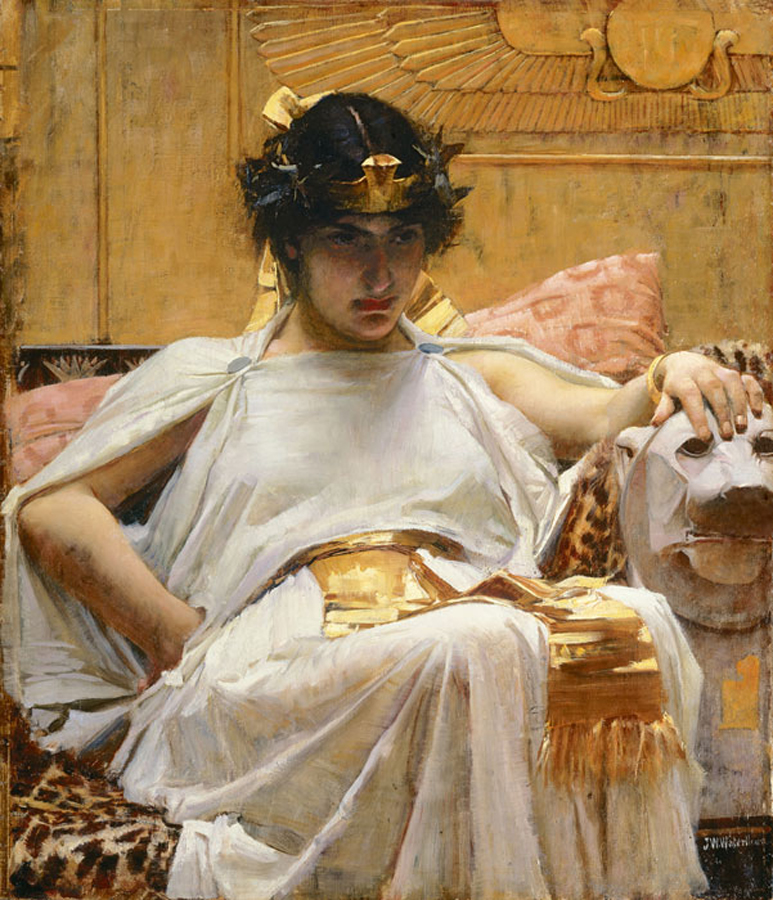
I got through a history! with a bit of help from wikipedia, i finished up Antony and Cleopatra today. The basic plot is that Antony is a Roman leader who has been in Egypt. He's in love with Cleopatra, Egypt's queen. Duty calls him back to Rome, where Octavius, the future first emperor of Rome, needs his help in war against Pompey. To try to seal the alliance, Antony marries Octavius' sister Octavia. Cleopatra doesn't like that very much. Antony and Octavius make a truce with Pompey. Then Antony comes back to Rome because Octavius breaks the truce and Antony doesn't want to be involved anymore. Then Octavius makes war on Egypt.
The history plays are more difficult for me. I found this one to be easier than the various English King plays but i did need a bit of help with the battles. The wikipedia summary of the plot made the sea battle debacles make sense. I knew the Roman history from college and my own general interest reading.
I'm not sure how i feel about this play. Who am i supposed to be rooting for? Cleopatra varies between girlish and petty to strong and noble. Antony seems really wishy washy. He loves Cleopatra when things are good but hates her when things are bad. Octavius is power hungry and not very relatable. I give this one a 4/7. I wouldn't mind seeing it live.
The history plays are more difficult for me. I found this one to be easier than the various English King plays but i did need a bit of help with the battles. The wikipedia summary of the plot made the sea battle debacles make sense. I knew the Roman history from college and my own general interest reading.
I'm not sure how i feel about this play. Who am i supposed to be rooting for? Cleopatra varies between girlish and petty to strong and noble. Antony seems really wishy washy. He loves Cleopatra when things are good but hates her when things are bad. Octavius is power hungry and not very relatable. I give this one a 4/7. I wouldn't mind seeing it live.
Wednesday, May 27, 2009
Review: The Sonnets - Warwick Collins
 *** - I love Shakespeare, and the sonnets are some of my favorites - heartfelt and beautiful, caught up in emotional turmoil. We once used certain sonnets as monologues in an acting class - there's just so much to them. Unfortunately here, I never got swept up in the emotions Shakespeare was writing about - the narration seemed detached.
 Warwick Collins' The Sonnets explores Shakespeare's life while he was writing his beautiful sonnets. The sonnets are often cited as the most autobiographical of Shakespeare's work, and here Collins rearranges and weaves them together to form a narrative about Shakespeare's love triangle with his patron the Earl of Southampton and the mysterious dark lady.
I loved the premise - using the sonnets as a basis for a historical novel about Shakespeare's life and loves is a brilliant idea and could really serve to infuse him with emotional life rather than the focus on the playhouse that most Shakespearean novels take. That said, I'm not sure the format wholly works here. In trying to let the sonnets speak for themselves by including so many of them, Collins doesn't give us much of his own interpretation of Shakespeare's emotions - which is problematic in a novel told in the first person. His Shakespeare seems overly detached from the world he inhabits - a characteristic often remarked upon by his patron, but which doesn't seem quite right given the deep conflicting emotions shown in his sonnets.
The method of incorporating the sonnets is also a bit awkward - even jarring. Often times they are introduced with a quick statement that Shakespeare has spent the night 'at his board'. Then the first two quartets (or so) are quoted, then the poem is taken over by one of his patrons reading aloud. This is very effective as a scene transition on film, but on the page it seemed strange and affected - particularly since it happened over and over again.
Writing about Shakespeare is difficult. Writing from Shakespeare's point of view is even more so. There are sections where I thought Collins succeeded admirably. On p. 72, a snippet of conversation:
"Thou art a flatterer."
"No better and no worse."
sounds just like the sort of rejoinder the playwright would come up with - it even scans. And further on that page there are sentences that flow in (almost) iambic pentameter:
"Inside the sullen gloom, his rooms were a scholar's den, with manuscripts piled high on chests and chairs."
Sections like this just sound RIGHT. They sound like something that could come from Shakespeare's quick mind. But all too often, I found myself as detached as Shakespeare was depicted. Partially this was due to differences in interpretation - Collins depicts Shakespeare's love for Southampton as ironic and chaste. I'm not sure I agree with either assessment. But mostly I think it was because Collins' reimagining in The Sonnets didn't offer enough emotional context to bring the poems to life in a new and different way.
Subscribe to:
Posts (Atom)