Wednesday, January 6, 2016
These are the Facts
I'm going to publish these basic facts as written by Mark Twain (Samuel Clemens) in 1909.
You can use these to refer to when I or anyone else is disputing something.
These facts come from the book - Is Shakespeare Dead? Chapter 3
This Book can be read on Project Gutenberg
All CAPS are in the Original Book.
__________________________________________________________
For the instruction of the ignorant I will make a list, now, of those details of Shakespeare's history which are FACTS--verified facts, established facts, undisputed
Facts
He was born on the 23d of April, 1564.
Of good farmer-class parents who could not read, could not write, could not sign their names.
At Stratford, a small back settlement which in that day was shabby and unclean, and densely illiterate. Of the nineteen important men charged with the government of the town, thirteen had to "make their mark" in attesting important documents, because they could not write their names.
Of the first eighteen years of his life NOTHING is known. They are a blank.
On the 27th of November (1582) William Shakespeare took out a license to marry Anne Whateley.
The very next day William Shakespeare took out a license to marry Anne Hathaway. She was eight years his senior. William Shakespeare married Anne Hathaway. In a hurry. By grace of a reluctantly granted dispensation there was but one publication of the banns. Within six months the first child was born.
About two (blank) years followed, during which period NOTHING AT ALL HAPPENED TO SHAKESPEARE, so far as anybody knows.
Then came twins--1585. February.
Two blank years follow.
Then--1587--he makes a ten-year visit to London, leaving the family behind.
Five blank years follow.
During this period NOTHING HAPPENED TO HIM, as far as anybody actually knows.
Then--1592--there is mention of him as an actor.
Next year--1593--his name appears in the official list of players.
Next year--1594--he played before the queen. A detail of no consequence: other obscurities did it every year of the forty-five of her reign. And remained obscure.
Three pretty full years follow. Full of play-acting. Then on 1597 he bought New Place, Stratford.
Thirteen or fourteen busy years follow; years in which he accumulated money, and also reputation as actor and manager. Meantime his name, liberally and variously spelt, had become associated with a number of great plays and poems, as (ostensibly) author of the same. Some of these, in these years and later, were pirated, but he made no protest.
Then--1610 or 1611--he returned to Stratford and settled down for good and all, and busied himself in lending money, trading in tithes, trading in land and houses, shirking a debt of forty-one shillings, borrowed by his wife during his long desertion of his family; suing debtors for shillings and coppers; being sued himself for shillings and coppers; and acting as confederate to a neighbor who tried to rob the town of its rights in a certain common, and did not succeed.
He lived five or six years--till 1616--in the joy of these elevated pursuits. Then he made a will, and signed each of its three pages with his name. A thoroughgoing business man's will. It named in minute detail every item of property he owned in the world--houses, lands, sword, silver-gilt bowl, and so on--all the way down to his "second-best bed" and its furniture. It carefully and calculatingly distributed his riches among the members of his family, overlooking no individual of it.
Not even his wife: the wife he had been enabled to marry in a hurry by urgent grace of a special dispensation before he was nineteen; the wife whom he had left husbandless so many years; the wife who had had to borrow forty-one shillings in her need, and which the lender was never able to collect of the prosperous husband, but died at last with the money still lacking. No, even this wife was remembered in Shakespeare's will. He left her that "second-best bed."
And NOT ANOTHER THING; not even a penny to bless her lucky widowhood with. It was eminently and conspicuously a business man's will, not a poet's.
It mentioned NOT A SINGLE BOOK. Books were much more precious than swords and silver-gilt bowls and second-best beds in those days, and when a departing person owned one he gave it a high place in his will. The will mentioned NOT A PLAY, NOT A POEM, NOT AN UNFINISHED LITERARY WORK, NOT A SCRAP OF MANUSCRIPT OF ANY KIND.
Many poets have died poor, but this is the only one in history that has died THIS poor; the others all left literary remains behind. Also a book. Maybe two.
If Shakespeare had owned a dog--but we not go into that: we know he would have mentioned it in his will. If a good dog, Susanna would have got it; if an inferior one his wife would have got a downer interest in it. I wish he had had a dog, just so we could see how painstakingly he would have divided that dog among the family, in his careful business way.
He signed the will in three places.
In earlier years he signed two other official documents.
These five signatures still exist.
There are NO OTHER SPECIMENS OF HIS PENMANSHIP IN EXISTENCE.
Not a line.
Was he prejudiced against the art? His granddaughter, whom he loved, was eight years old when he died, yet she had had no teaching, he left no provision for her education, although he was rich, and in her mature womanhood she couldn't write and couldn't tell her husband's manuscript from anybody else's. She thought it was Shakespeare's.
When Shakespeare died in Stratford, IT WAS NOT AN EVENT. It made no more stir in England than the death of any other forgotten theater-actor would have made. Nobody came down from London; there were no lamenting poems, no eulogies, no national tears--there was merely silence, and nothing more. A striking contrast with what happened when Ben Jonson, and Francis Bacon, and Spenser, and Raleigh, and the other distinguished literary folk of Shakespeare's time passed from life! No praiseful voice was lifted for the lost Bard of Avon; even Ben Jonson waited seven years before he lifted his.
SO FAR AS ANYBODY ACTUALLY KNOWS AND CAN PROVE, Shakespeare of Stratford-on-Avon never wrote a play in his life.
SO FAR AS ANY ONE KNOWS, HE RECEIVED ONLY ONE LETTER DURING HIS LIFE.
So far as any one KNOWS AND CAN PROVE, Shakespeare of Stratford wrote only one poem during his life. This one is authentic. He did write that one--a fact which stands undisputed; he wrote the whole of it; he wrote the whole of it out of his own head. He commanded that this work of art be engraved upon his tomb, and he was obeyed. There it abides to this day. This is it:
Good friend for Iesus sake forbeare
To digg the dust encloased heare:
Blest be ye man yt spares thes stones
And curst be he yt moves my bones.
In the list as above set down will be found EVERY POSITIVELY KNOWN fact of Shakespeare's life, lean and meager as the invoice is. Beyond these details we know NOT A THING about him.
All the rest of his vast history, as furnished by the biographers, is built up, course upon course, of guesses, inferences, theories, conjectures--an Eiffel Tower of artificialities rising sky-high from a very flat and very thin foundation of inconsequential facts.

Monday, January 4, 2016
Authorship Debate Challenge for 2016
WOW - I haven't touched this blog for 6 years!!!
So I am going to restart it back up and do an AUTHORSHIP DEBATE challenge for 2016.
This is being done to celebrate the 400th anniversary of the death of the Man from Stratford - whomever he was.
The rules are simple.
Read any 5 books on the Authorship debate and leave your comments and links in my comments on this blog.
There are no other restrictions, You can read both Fiction and/or Non-fiction.
You have pretty much ONE year to read 5 books.
So this challenge will end on December 31, 2016.
I don't require a list, but if you wish to make one, you can do so, and leave a list in the comments.
Dont forget to leave a link to your blogs as well. I may add a new post with those links for easy access.
Let me see - those books that I currently own and have not yet read about the debate include the following.
Sally O'Reilly - Shakespeare's Dark Lady (Amelia Bassano)
Ian Wilson - Shakespeare the Evidence
Mark Anderson - Shakespeare by Another Name (Oxford)
Rodney Bolt - History Play (Kit Marlowe)
Robin Williams - Sweet Swan of Avon (Mary Sidney)
These are all non fiction. I have read some fiction books on this debate. You can look for them in earlier posts of this blog.
Please leave me a comment below if you plan on entering.
I dont expect you to have formed any opinion on who the real author might be. You can mention your opinion in your posts or not, that's your decision.
I just want readers to know that there are other choices out there for who could possibly be the authors of those plays, other than the man from Stratford on Avon.
I dont use any of those Linky thingamajigs - call me old fashioned but I have had a look and they look COMPLICATED!! LOL
If you read back over all the older posts, I did previously allow others to join this blog, but have now removed all those names
(except for 2 people I personally know)
Sunday, November 15, 2009
Enter Three Witches - Caroline B. Cooney

****1/2 - I really enjoyed this spooky retelling of Shakespeare's Scottish play - particularly where Cooney incorporates quotes as part of the dialogue. I enjoyed seeing the action from several characters' points of view. I did think the resolution was rather abrupt and not nearly as climactic as it should have been.
Soldiers are gathering throughout Scotland, preparing for a great battle against the traitor who stands against the much-loved King Duncan, but nothing prepared Lady Mary for the news that her own father was a traitor to the crown and that her betrothed was killed in battle. Now Mary fears for her own life, especially as she slowly comes to realize the depths her guardians Lord and Lady MacBeth are willing to plumb in order to satisfy their cravings for power. Mary is trapped in a castle with nothing to warn her who not to trust except the pricking of her thumbs…
Enter Three Witches was a creepy atmospheric story set in gloomy castles among the fog-ridden bogs of Scotland crawling with witches demanding sacrifice and eager to share ominous portends of things to come. And mixed up in the middle of the intrigues of Shakespeare's Scottish play are fourteen-year-old Mary whose rich inherited lands make her a tantalizing matrimonial prize and Banquo's son Fleance whose need to prove himself keeps landing him in difficult situations. I really liked these two main characters (especially Fleance) and enjoyed reading the sections told from their point of view. Mary in particular is resourceful and brave, and she never felt unrealistic to me.
But however much I liked Mary, and for all the Shakespeare quotes sprinkled throughout, I felt that the most climactic bits of the play (Birnam Wood marching on Dunsinane; the final battle) were given only fleeting treatment in the book which seemed a shame. But the rich background Cooney gives the characters of the original play (and those that she adds) make for a compelling read - and one that had me reaching for my copy of Shakespeare as the author exhorts at the end.
I would definitely recommend Enter Three Witches for those struggling to get into Shakespeare's play - of for those that want a creepy Gothic young adult book to curl up with on a dreary day.
Monday, August 31, 2009
Henry IV, Part 1 on Audio
I listened to Henry IV Part 1 by William Shakespeare over this past weekend. a 3 cd set goes by pretty quickly on a 90 mile each way trip. I'm glad i picked this one up.
Henry IV Part 1 is a history play. It has one of the best comedic characters ever written: Sir John Falstaff. I'm not sure how he got the Sir as he seems to be more a brigand. Henry, called Harry or Hal, is the heir apparent to King Henry IV. He is something of a prodigal son; he parties and drinks and carouses with unsavory characters. Falstaff appears to be his best friend. King Henry's former friends and confidante's have rebelled against him for various reasons, led by the Earl of Northumberland and his son Henry Percy, also called Harry or Hotspur. King Henry calls his men to fight: Prince Hal swears to redeem himself by earning glory in combat; Falstaff does his best to take care of himself.
The production was fantastic. I immediately added Part 2 onto my library request list. You don't just get different people for each part, you hear glasses clinking, swords ringing, horses galloping. People get out of breath and burb and drink. I can't recommend the Arkangel production enough.
Henry IV Part 1 is a history play. It has one of the best comedic characters ever written: Sir John Falstaff. I'm not sure how he got the Sir as he seems to be more a brigand. Henry, called Harry or Hal, is the heir apparent to King Henry IV. He is something of a prodigal son; he parties and drinks and carouses with unsavory characters. Falstaff appears to be his best friend. King Henry's former friends and confidante's have rebelled against him for various reasons, led by the Earl of Northumberland and his son Henry Percy, also called Harry or Hotspur. King Henry calls his men to fight: Prince Hal swears to redeem himself by earning glory in combat; Falstaff does his best to take care of himself.
The production was fantastic. I immediately added Part 2 onto my library request list. You don't just get different people for each part, you hear glasses clinking, swords ringing, horses galloping. People get out of breath and burb and drink. I can't recommend the Arkangel production enough.
Monday, August 24, 2009
Taming of the Shrew- John Mutford's 3rd Review
 A friend of mine recently told me that she acted in The Taming of The Shrew in her theatre days and because of that it's one of her favourites. Knowing nothing about the play, when it was time to read another Shakespeare play I chose it. I wasn't far in before I had to ask, "you didn't find it all offensive?"
For those in the dark, as I was, the "shrew" is in fact a woman named Kate and the "taming" is a series of emotionally cruel treatments that results in her taking a subordinate position to her husband. If he decides to call the sun the moon, then Kate, too, will call the sun the moon. And it's a comedy.
It turns out that my friend's theatre troupe did as many modern reproductions do: they made Kate's transformation disingenuous. They didn't change any lines per se (though some do), but had the actress deliver them sarcastically.
When Kate lectures the other women at the end, for instance, that men are superior and women must obey, a few simple eye-rolls and the right tone suggest to an audience that she has not been converted at all.
Whether or not Shakespeare intended it this way (I personally think he intended it the misogynistic way), I doubt a modern performance could get away with doing otherwise. But the question remains: does it work?
I'd have to see it performed, and performed well, to pass judgement, but I'm very skeptical. The play oozes cruelty; from the opening framework which targets the lower class, to the play-at-large which targets women, everything is done for laughs. The insults are Shakespearean, and thus should be amusing and witty, but it was hard for me to enjoy myself when some of the characters were being treated so poorly, and without any really nice characters to balance it out. I'll grant, for instance, that Kate wasn't a nice person at the beginning. Had Shakespeare made Petruchio, her husband, a likable character and the victim of Kate's mean behaviour, a reader might be able to at least view Petruchio's later treatment of her as revenge. Not that it would condone cruelty since two wrongs don't make a right, as the saying goes, but at least there'd be some sense of vindication.
On another note, it was only after searching up the play online that I learned it was the basis behind Heath Ledger's Ten Things I Hate About You. I can't say I had any interest in seeing it before, but now I'm a bit curious. Have you seen it?
(Cross posted at The Book Mine Set).
Sunday, June 14, 2009
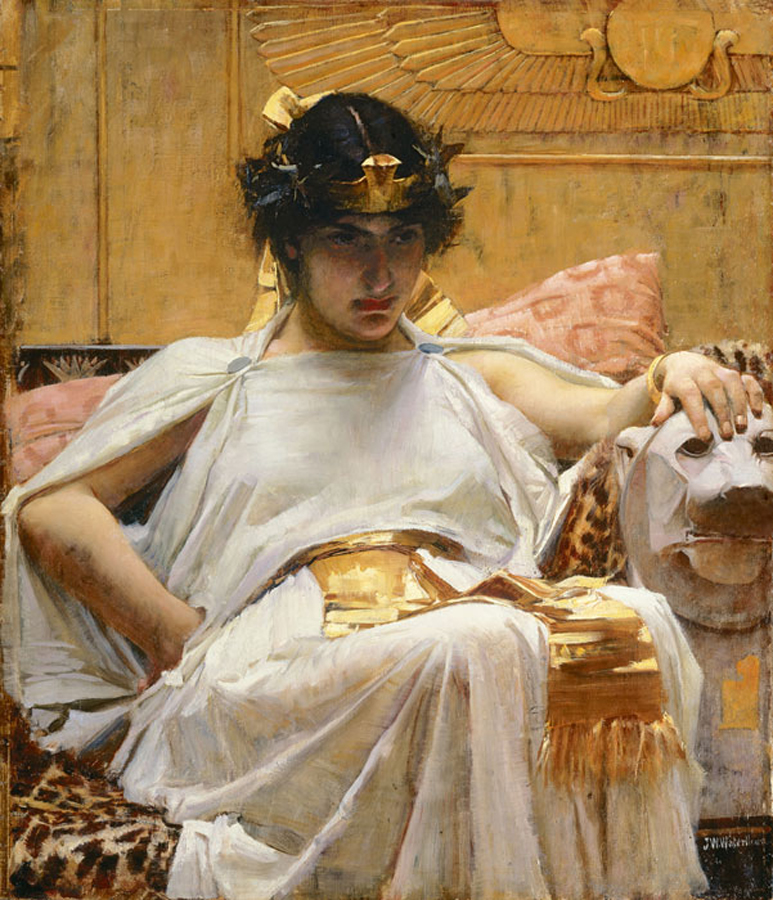
I got through a history! with a bit of help from wikipedia, i finished up Antony and Cleopatra today. The basic plot is that Antony is a Roman leader who has been in Egypt. He's in love with Cleopatra, Egypt's queen. Duty calls him back to Rome, where Octavius, the future first emperor of Rome, needs his help in war against Pompey. To try to seal the alliance, Antony marries Octavius' sister Octavia. Cleopatra doesn't like that very much. Antony and Octavius make a truce with Pompey. Then Antony comes back to Rome because Octavius breaks the truce and Antony doesn't want to be involved anymore. Then Octavius makes war on Egypt.
The history plays are more difficult for me. I found this one to be easier than the various English King plays but i did need a bit of help with the battles. The wikipedia summary of the plot made the sea battle debacles make sense. I knew the Roman history from college and my own general interest reading.
I'm not sure how i feel about this play. Who am i supposed to be rooting for? Cleopatra varies between girlish and petty to strong and noble. Antony seems really wishy washy. He loves Cleopatra when things are good but hates her when things are bad. Octavius is power hungry and not very relatable. I give this one a 4/7. I wouldn't mind seeing it live.
The history plays are more difficult for me. I found this one to be easier than the various English King plays but i did need a bit of help with the battles. The wikipedia summary of the plot made the sea battle debacles make sense. I knew the Roman history from college and my own general interest reading.
I'm not sure how i feel about this play. Who am i supposed to be rooting for? Cleopatra varies between girlish and petty to strong and noble. Antony seems really wishy washy. He loves Cleopatra when things are good but hates her when things are bad. Octavius is power hungry and not very relatable. I give this one a 4/7. I wouldn't mind seeing it live.
Wednesday, May 27, 2009
Review: The Sonnets - Warwick Collins
 *** - I love Shakespeare, and the sonnets are some of my favorites - heartfelt and beautiful, caught up in emotional turmoil. We once used certain sonnets as monologues in an acting class - there's just so much to them. Unfortunately here, I never got swept up in the emotions Shakespeare was writing about - the narration seemed detached.
 Warwick Collins' The Sonnets explores Shakespeare's life while he was writing his beautiful sonnets. The sonnets are often cited as the most autobiographical of Shakespeare's work, and here Collins rearranges and weaves them together to form a narrative about Shakespeare's love triangle with his patron the Earl of Southampton and the mysterious dark lady.
I loved the premise - using the sonnets as a basis for a historical novel about Shakespeare's life and loves is a brilliant idea and could really serve to infuse him with emotional life rather than the focus on the playhouse that most Shakespearean novels take. That said, I'm not sure the format wholly works here. In trying to let the sonnets speak for themselves by including so many of them, Collins doesn't give us much of his own interpretation of Shakespeare's emotions - which is problematic in a novel told in the first person. His Shakespeare seems overly detached from the world he inhabits - a characteristic often remarked upon by his patron, but which doesn't seem quite right given the deep conflicting emotions shown in his sonnets.
The method of incorporating the sonnets is also a bit awkward - even jarring. Often times they are introduced with a quick statement that Shakespeare has spent the night 'at his board'. Then the first two quartets (or so) are quoted, then the poem is taken over by one of his patrons reading aloud. This is very effective as a scene transition on film, but on the page it seemed strange and affected - particularly since it happened over and over again.
Writing about Shakespeare is difficult. Writing from Shakespeare's point of view is even more so. There are sections where I thought Collins succeeded admirably. On p. 72, a snippet of conversation:
"Thou art a flatterer."
"No better and no worse."
sounds just like the sort of rejoinder the playwright would come up with - it even scans. And further on that page there are sentences that flow in (almost) iambic pentameter:
"Inside the sullen gloom, his rooms were a scholar's den, with manuscripts piled high on chests and chairs."
Sections like this just sound RIGHT. They sound like something that could come from Shakespeare's quick mind. But all too often, I found myself as detached as Shakespeare was depicted. Partially this was due to differences in interpretation - Collins depicts Shakespeare's love for Southampton as ironic and chaste. I'm not sure I agree with either assessment. But mostly I think it was because Collins' reimagining in The Sonnets didn't offer enough emotional context to bring the poems to life in a new and different way.
Sunday, April 12, 2009
Shakespeare's Face - Book Review
 Shakespeare's Face
By Stephanie Nolen
Alfred Knopf Canada
2002
Stephanie's website
LARGE Sanders Portrait on the right

I thought it timely to read this book after the most recent portrait was discovered. (see the large Sanders Portrait link above. The Cobbes portrait is on the left).
But since the Cobbes Portrait has now been identified as actually being Sir Thomas Overbury, then the Sanders Portrait may still be in the running.
This was an excellent book to read. There are some chapters written by Stephanie Nolen and others by other experts who have written about this portrait and why it may or may not be Shakespeare. Stephanie writes about how she discovered the portrait, and she tells the story of the Sanders family who owned the portrait and how it came to be in Canada. Stephanie describes all the testing that was done. Most of it was done by the Canadian Conservation Institute in Ottawa.
The Sanders portrait was painted in 1603 - the year 1603 is painted at the top right hand corner. The wood, and the paint are all dated to the Elizbethan era or before so it is from the right time. The label on the back is the big questions. Since the painting was done in 1603 (Shakespeare would have been 39 that year) there is alabel affixed to the back that states year of birth and year of death, so the label at least was not attached at the time the painting was done. It was attached sometime after Shakespeare died in 1616. This alone is suspicous and may mean that the painting was NOT painted in 1603.
Some of the chapters in this book are written by the experts. Some of them are a little dry, as only experts can be. Other experts chapters are interesting.
The last chapter has summaries by the experts on who they think the portrait may be of. All of them say that this is NOT a portrait of William Shakepeare, because it is so different from the Droeshout print from the first Folio. Only one expert offers a plausible guess as to who the man in the portrait may be.
In 1603, William Shakespeare was aged 39. In that same year, his future writing partner John Fletcher, was just 24. He does have light coloured hair and a receding hairline. This portrait does look more like a young man of 24, and not so much of a man about to turn 40.
Here is another recent review of this same book.
So do YOU think this portrait is of a 39 year old or a 24 years old??
Saturday, April 4, 2009
Timon of Athens- John Mutford's 2nd Review
 This is the first Shakespearean play I've read since coming back from seeing his birthplace, the Globe reproduction and his grave. I was wondering how those experiences would affect my reading and while it did provide a little more perspective, I don't think it affected my enjoyment one way or the other.
During the tour of his birthplace, our tour guide briefly mentioned how William's father John had gone bankrupt. In the play, Timon also goes bankrupt. I wondered if Timon shared any personality traits with the bard's father.
Timon basically doesn't know how to hang onto his cash. Surrounded by flatterers and false friends, he ends up giving away everything he has. When his creditors come calling, Timon sends out requests to all those he's helped in the past but, to his bitter surprise, none return the favour. He goes from being a wealthy philanthropic lord to a bankrupt misanthropist, running away from his debts and reviled society to live in a cave. However, at the cave Timon discovers gold. Will he hold onto his wealth this time?
Not at all. Timon gives it all away once again. However, this time it's out of hatred, not love. He hands it out to whores to spread disease, to a banished military captain who plans vengeance on Athens, and the rest to an artist, a poet, and a little left over to some senators who come to visit.
Apparently he's as disillusioned with money as he is humanity.
My first feeling toward Timon was that he was an idiot. One of my faults with the play was the lack of explanation of how a man this stupid and careless with money would have had any to begin with. He has extraordinary luck to happen upon the stash of gold, then blows his one chance to get back on his feet. Unforgivable?
Maybe. Maybe not. The cynical side of me thinks that his disillusionment, especially with money, might have led to the wisest decision of all: getting rid of it. Wishing venereal disease on his fellow countrymen? Well, I don't condone that.
It's a more obscure play but I quite enjoyed it.
(Cross-referenced at the Book Mine Set and The Obscure Challenge.)
Tuesday, March 24, 2009
About that new Shakespeare Portrait
 The Cobbe Portrait from 2 weeks ago, said to be that of Shakespeare.
 Well the truth is out at last.
The Jacobean painting from the family collection of art restorer Alec Cobbe was thought to be the bard because it closely resembled the engraving in Shakespeare's First Folio. It is also noticeably similar to another painting believed to be the playwright owned by the Folger Shakespeare Library in Washington, DC.
Dr Tanya Cooper, the sixteenth-century curator at the National Portrait Gallery in London, believes the portrait bears a greater likeness to Sir Thomas Ovebury. She told The Times: “if anything, both works, the Folger and Cobbe portraits, are more likely to represent the courtier Sir Thomas Overbury".
This means the Folger library in Washington DC has been deliberately committing a fraud for a number of years, by showing a picture claiming it to be Shakespeare. BUT they could not be bothered to pay a little money for an airfare and actually go visit the National Gallery in UK and see for themselves that their portrait is a fraud.
 This portrait of Sir Thomas Overbury is in the National Gallery of England.
The Cobbe family claimed their picture to be Shakespeare because it was the same as the picture in the Folger library. That is an error that an amateur art historian might make. BUT NOT for a professional library like the Folger.
Sir Thomas Overbury (1581 - September 15, 1613) was the son of Nicholas Overbury, of Bourton-on-the-Hill, and was born at Compton Scorpion, near Ilmington, in Warwickshire.
He was also an English poet and essayist, and the victim of one of the most sensational crimes in English history.
Just look at those dates. Overbury was born 16 years after Shakespeare and would have been aged 32 when he died. Remember how I remarked that the portrait did not look like a man of 46 years in that era? I was right.
And now experts believe the elaborate lace collar and gold embroided doublet are too grand for the playwright. Which is exactly what I said!!!!
According to the BBC, the Jansson Portrait of Shakespeare, which was painted in 1610, is also considered to be that of Sir Thomas Overbury, and not Shakespeare.
Painted around 1610, (the Jannson) work emerged as a compelling candidate as a life portrait of Shakespeare in the later 18th Century. Now, however, the sitter is believed to be the courtier and author Sir Thomas Overbury (1581-1613), while Cornelis Janssen (1593-1661) is no longer accepted as the artist.
How interesting that the Cobbe picture was also painted in 1610. Would Shakespeare have been able to afford to commission TWO portraits of himself in the same year? I seriously doubt it.
So, what does all this mean? Well I personally think this whole mess means that the Sanders portrait found in Canada is most likely still the only true likeness of William Shakespeare. Cobbe portrait on the left, Sanders portrait on the right. I must read the book.
Tuesday, March 17, 2009
Shakespeare: The World As Stage
Yesterday I read Shakespeare: The World As Stage by Bill Bryson. In this very small book, Bryson says he sums up all the real facts that we have about Shakespeare. There aren't many. We know the date he was christened but not the exact date of birth. We know when he married, how many legitimate children he had, what property he bought and sold, but not the first performance dates of the majority of his plays or what order his sonnets should be in. And we know almost nothing about his personality. Bryson tries to avoid extrapolating Shakespeare's personality and character from the text of the plays but he does talk about other analyses that do have some validity. He mentions the reason that Shakespeare had to know some Italian is because a few of his plays are cribbed from Italian works that had not been translated to English.
Bryson devotes a chapter to the "other author" theories and i have to say he's pretty convincing that Shakespeare wrote Shakespeare. Apparently there was no controversy at all until the 1850's when an American woman, Delia Bacon, wrote a book implying that Francis Bacon wrote the Shakespeare plays. She came up with this idea by traveling to Bacon's hometown and picking up mental vibes. Ugh. He writes about the various conspiracies that would have to be in place for others besides Shakespeare to write the plays.
Overall this book is a nice overview of what we know, or don't know, about Shakespeare.
Bryson devotes a chapter to the "other author" theories and i have to say he's pretty convincing that Shakespeare wrote Shakespeare. Apparently there was no controversy at all until the 1850's when an American woman, Delia Bacon, wrote a book implying that Francis Bacon wrote the Shakespeare plays. She came up with this idea by traveling to Bacon's hometown and picking up mental vibes. Ugh. He writes about the various conspiracies that would have to be in place for others besides Shakespeare to write the plays.
Overall this book is a nice overview of what we know, or don't know, about Shakespeare.
Tuesday, March 10, 2009
New Shakespeare Portrait Found
One of the books I was planning to read for this Shakespeare Challenge is called Shakespeare's Face about the Sanders portrait found in Canada. But today there is news that another new portrait has been identified and has been claimed to now be THE DEFINITIVE portrait of Shakespeare.
The first thing I said to myself when I saw this portrait was - too upper class. Just look at the neck collar. Only the rich wore those and Shakespeare was NOT rich.
And at aged 46 - I would have thought that in that era Shakespeare looked a lot older than this person does. This fellow has a full head of hair. The Droushout portrait from the First Folio shows a definite receding hairline, making the man look older.
In fact I think it's Henry Wriothesley. He does have a moustache as well. You cannot see the long hair that Wriosthesley had. But then, with such a dark background, you cant tell if this fellow has any hair either.
01.jpg)
It is interesting that the family who held onto this portrait for so many generations, was distantly related to the Wriothesley Family. And now conveniently they wish to cash in in these hard economic times.
The portrait has been in the Cobbe family for generations. The family is distantly related to Shakespeare's only known literary patron, Henry Wriothesley, the third Earl of Southampton.
Another possibility is Sir Henry Neville - who is one of the possible candidates to be the author of the plays.
Monday, March 9, 2009
Will in the World by Stephen Greenblatt
Much of the life of William Shakespeare is a mystery. He carefully did not keep a diary nor send love letters to his wife. Shakespeare, the prolific writer who, in just over 50 years wrote an almost unbelievable number of remarkable poems and plays, did not leave many personal details of his life beyond public records (which are spotty 400 years later). There was not a market for biographies of famous playwrights in the 1600s, and many details of his life were not written down until he was long gone.

A more detailed review of Will in the World is on Rebecca Reads. This is my first read for the 2009 BiblioShakespeare challenge.
Saturday, February 28, 2009
Manga Shakespeare: Macbeth
 By the pricking of my thumbs,
Something wicked this way comes.
Manga Shakespeare: Macbeth is the very first Manga book I've ever read, and I enjoyed the experience. I've known very little about graphic novels or Manga, but I'm learning! And I do love Shakespeare in any form, and especially love his MACBETH. Before moving to 2nd grade after my medical leave of absence, I taught 6th grade for 16 years, and our 6th grade classes performed an abbreviated version of The Scottish Play every spring. It's the thing I miss most about my grade level change. So it was a pleasure to read another version of the play, and experience it in a whole new way.
 The world of Manga is quite fascinating. There are visual traditions and things I don't completely understand yet (MacDuff had 4 arms, for instance, and the story was set in a post-apocalyptic future), but I know that there was always a real fascination and passion for it with some of my students, so I am curious to read more and learn about it. I am also pleased that the Manga Shakespeare books introduce readers, many of them young, to the plays in a way they can enjoy. The language is intact although abbreviated, and "reading" a Manga or graphic novel version of the story should probably be called "experiencing" the book because it is much closer to a performance of the play because of the interaction of the words and the graphic art.
Saturday, February 7, 2009
Will - Book Review
 Will
WillBy Grace Tiffany
Berkeley Publishing 2004
For those of you reading this blog, you should know by now, that I do not accept the premise that William, the man from Stratford, actually wrote the plays.
But this novel is written in a very believeable way that explains how William got to know all about those European places that are mentioned in the plays, without having lived there himself.
This novel covers William from the time he got Anne Hathaway pregnant and was forced to marry her, to the time he left London and retired back to Stratford. Roughly between 30 and 40 years.
It explains how William was educated. Mostly by the local school masters in Latin, but William learnt his greek from reading greek books at his great-uncle's library. Remember, William's mother Mary Arden was of a minor noble family. Mary's uncle Edward Arden was beheaded for suspicion of being a Papist (or a Catholic - which he was) before William was 20. Arden's head was stuck on a pole in London for a few years.
After William and Anne Hathaway were married, because she was in the family way, William took off for London.
One of the first people William met in London was Kit Marlowe. There was competition between them. Originally William began writing conversations in a new manner - quick repartee between characters rather than long monologues. Kit stole the concept from William and used it for one of his plays. William was most upset. They didn't speak for a number of years, until Kit was killed in a Deptford tavern.
Then William was taken to the Earl of Southampton's house, where Henry Wriothesley (the Earl) took a fancy to him. The word is never mentioned but the book implies that Henry was either homosexual or trans-sexual. He liked to dress up in women's clothing. He was eventually married off to a woman he didnt particularly like, but he did want to seem to look normal. Henry commanded William to write him some poems, so William wrote his sonnets praising Henry. Henry promised to keep them safe and to not publish them.
While he was at Henry's house, William met Emilia, a young and unhappy Italian noblewoman who was married to an English nobleman. William pumped this women for information about life in the Italian nobility, and they slept together as well. This is supposedly how William learnt so much about Italy.
William had originally had been working for Kit's group of players, but after they fell out, William moved to a new group where he got a job as a bit part actor and started seriously writing plays. Henry Wriothesley had plenty of money which he loaned to William to enable to William to write his plays. Eventually the players began producing and performing Will's plays.
Some years later Emilia published the sonnets. She told William she had found them amongst Henry's books and had copied them.
The novel mentions Henslow, Babbage, Cuminge, and Ben Jonson and all those other names associated with William Shakespeare. William also gets to meet Queen Elizabeth, the Scottish King James, the poet John Donne and even Pocahantas. (Did Pocahantas really go to England?)
If you did not know about the controversy over whether or not William actually wrote the plays, you would actually beleive this story entirely, and be convinced that William Shakespeare from Stratford did write those plays.
I enjoyed this story much more than I thought I would. I had tried to read Tiffany's earlier book, My Father had a Daughter some time ago, but for some reason, I just couldnt get into that one.
This is my first book for the Shakespeare challenge.
Monday, January 26, 2009
John's First Play Down! (The Winter's Tale)
 I was really enjoying the first part of Shakespeare's The Winter's Tale with its emphasis on jealousy. Leontes, King of Sicilia, tries to convince his friend Polixenes, King of Bohemia, to visit a little longer. When Leontes is unsuccessful in his plea, he casually asks his wife Hermione to try. Without much effort, she convinces Polixenes to stay, sparking suspicions from Leontes. Quickly his suspicions deteriorate into a rage, leading Polixenes to flea and Leontes to throw his pregnant wife (whom he now believes to be carrying Polixenes baby) in prison. Meanwhile, practically everyone tries to convince him of his wife's innocence.
Up to this point it's an intense piece of psychodrama. As Shakespeare goes, it's probably one of his more accessible plays, plus it's a theme as relevant today as it was then no matter in what class or country one lives. What made Leontes suddenly snap? Did he always have jealous tendencies but they just now awakened? Was there some festering issue between him and Polixenes that finally came to the fore? The play could have explored this angle but Shakespeare chose not to delve into the past. How low would Leontes sink? It could have been fun, in a morbid sense, to watch his demise. However, his realization that he's erred comes quite early in the play, at which point the play takes a 90 degree turn in a different direction.
The latter half of the play, 16 years later, becomes a love story between Perdita (the daughter of Leontes and Hermione) and Florizel (Polixenes' son). It's not that I couldn't have enjoyed a love story, but I found the earlier jealousy story much more compelling. Plus, I found some of the characters in the second half (particularly Autolycus) quite annoying.
Compared with the other Shakespeare plays that I've read, the first three acts of The Winter's Tale ranks up there with my favourites. However, with the sudden switch in tone and plot, leaving a latter half that was just mediocre, I felt disappointed overall.
(Cross posted at The Book Mine Set)
Monday, January 19, 2009
Nashville Area Production
So if anyone is going to be in/around Nashville, TN in the next couple weeks the Nashville Shakespeare Festival is producing a great version of Richard III. I went last Friday evening and the crowd was pretty decent for only the second performance. Set in a vaudeville theater, the play was very different than some i've seen before. The couple of histories i've seen were straight Renaissance-style productions. In this though, the messengers are telegram girls, the two princes tapdance their way to the Tower of London and the men swill martinis! I enjoyed the change. There was a little dancing and singing but it wasn't a really a musical. The Troutt theater on Belmont's campus is a great venue; it used to be a church and has beautiful woodwork and marble. The play runs through Feb 1st and i highly recommend it.
Thursday, January 15, 2009
Kathrin's Shakespeare picks
I'm so sorry, but I completely forgot to post my list of books to read for the challenge here! I haven't decided on all 6 books I'll be reading yet, but here's a tentative list:
1) Shakespeare's Sonnets
2) William Shakespeare: Hamlet
3)
4)
5)
6)
1) Shakespeare's Sonnets
2) William Shakespeare: Hamlet
3)
4)
5)
6)
Monday, January 5, 2009
An Introduction to Shakespeare
 My fellow blogger, Mental Multivitamin, introduced me to Harold Bloom's term "bardalotry:"
...the worship of Shakespeare, ought to be even more a secular religion than it already is. The plays remain the outward limit of human achievement: aesthetically, cognitively, in certain ways morally, even spiritually. They abide beyond the end of the mind's reach; we cannot catch up to them. Shakespeare will go on explaining us, in part because he invented us....So, as one who practices bardalotry ... I'm always looking for good books on Shakespeare, and also for good books to introduce Shakespeare to young people, and I recently stumbled across a very nice series. I was slightly familiar with author, Marchette Chute, because my second grade students memorize and recite one of her little poems as one of their monthly poem projects. But as I was looking for books to choose for Historia's 2009 Shakespeare Reading Challenge, I ran into her again. Her series is very nice, for young and old alike, introducing them to Shakespeare, his worlds, and his plays! While snowbound last week, I read her book, An Introduction to Shakespeare, and enjoyed it. It's an old Scholastic paperback, geared for middle school and above, and the blurp on the back cover made me chuckle. It says the book is "A great grade booster you'll really enjoy. Score some extra points in class -- and add new meaning and excitement to your assigned reading. Journey back in time with this lively book that brings to life the world of William Shakespeare -- the greatest playwright who ever lived!"
I didn't find it lively, but I was very interested in all the information she packed into this small volume, and how easy it was to read and understand. She was very respectful of her audience, and wrote with great warmth. I learned a lot about Shakespeare that I didn't previously know, and I think this would be an excellent book to use as part of an introductory class. She wrote numerous other books, two of which I now plan to read for Historia's reading challenge:
*The Worlds of Shakespeare
*Stories From Shakespeare
From the ending to An Introduction to Shakespeare:
Among all Shakespeare's contemporaries, it was John Heminges and Henry Condell who had the greatest faith in the future. They were convinced that the reputation of their "friend and fellow" would be safe if only his work could be made available to the ordinary reading public.This was a very nice book to read to begin my Shakespeare Reading Challenge.
...It is not our province, who only gather his works and give them to you, to praise him. It is yours that read him ... Read him, therefore; and again and again; and if then you do not like him, surely you are in manifest danger not to understand him. And so we leave him to other of his friends, whom, if you need, can be your guides; if you need them not, you can lead yourselves and
others. And such readers we wish him.
--John Heminges and Henry Condell
Their wish was answered. It was such readers he got, and no other writer in the world's history has been loved by so many people or has given so much happiness.
(Cross-posted at A Fondness For Reading)
Saturday, January 3, 2009
Ragdoll - Shakespeare by Bill Bryson
 Here's my first book for the challenge -- originally posted over at My Tragic Right Hip.
Years ago when I worked at History Television, I wrote a series of articles about Shakespeare. For a few weeks, I was obsessed by the Shakespeare question and read a pile of books both for and against the Bard's "real" identity. I've seen Shakespeare in Love about a million times and even wrote an article for the now-defunct Chicklit.com (I wish I had a copy of it to share; it was a fun article to write) about the differences between the writer's life and how he was portrayed in the film, tying everything back into the research that I did for my job at the time. Needless to say, I think I'm more obsessed with the idea of all the controversy around Shakespeare's identity than I am by the man's work. Is that a bad thing? And let me just say for the record that I believe, as does Bill Bryson, that Shakespeare was the author of his work, not Francis Bacon or any number of other writers put forth in the years since his death and ultimate canonization.
Part of the Eminent Lives series, Bill Bryson's excellent Shakespeare: The World as Stage contextualizes the little known facts of the Bard's life into a compact and utterly readable package. As Bryson continually reminds us, there are very few known facts of Shakespeare's life: the date of his baptism, his marriage, the number of children he had, how many signatures exist (6), his will, etc. The rest is conjecture, scholars over the years uncovering new evidence, failing to prove their theories, and wishful thinking. What Bryson does so ingeniously is fill in his own spaces with interesting bits of history from the time period, padding Shakespeare's life with surrounding information, giving the reader a spirit of the age rather than trying to pull a biography from thin air. He addresses the Shakespeare question toward the end of the book, and I enjoyed reading about the interesting characters who contributed to seemingly never-ending debate.
I have to admit that I found the chapter about the plays themselves a little dry, but then he grabbed me again by making the point that part of Shakespeare's lasting impression on literature goes so far beyond the plays. So much of the language we use today, so many expressions that hadn't been used before are attributed to him, parts of our speech that we take so for granted that we barely give a thought to the fact that he wrote "be cruel to be kind." The book is full of information that could give anyone an edge should they end up on Jeopardy faced with a Shakespeare category, but it also has a grand sense of humour and a calm approach to sifting through what must have been miles upon miles of scholarship. By the nature of the lack of information about Shakespeare's life, it must have been hard to write a biography about him, but I think that Bryson's done a smashing job of it: a little Tom Stoppard, a little The Professor and the Madman, and a lot of what Bryson does so very well, write history so that it's engaging, interesting and utterly compelling.
Subscribe to:
Posts (Atom)